Cotton Sheeting Fabrics
.png)
The Everyday Cotton Fabric That Does More Than Bedsheets
When you hear cotton sheeting, the first thing that probably comes to mind is a bedsheet.
And that makes sense.
Cotton sheeting has been used for bed linen for generations because it is lightweight, breathable, comfortable and practical. But today, sheeting has moved well beyond the bedroom.
The same broad category of fabric can become a hotel bedsheet, hospital linen, a block-printed home textile, a screen-printed furnishing fabric or a digitally printed design base.
That is what makes cotton sheeting interesting.
It isn't a fabric with just one job. It is a fabric that adapts to the job.
What Exactly Is Cotton Sheeting?
Cotton sheeting is a lightweight, closely woven cotton fabric, generally made in a plain weave.
Its construction gives it a relatively even surface and a practical balance of comfort, strength and breathability. These characteristics are why sheeting has become closely associated with bedding and home textiles. It can also be dyed and printed, which makes it useful far beyond plain bedsheets.
But there is an important point buyers should know:
Cotton sheeting is not one fixed specification.
There isn't one universal “cotton sheeting GSM” or one construction that defines every sheeting fabric.
Different yarn counts, constructions, densities, finishes and weights can all fall under the broader sheeting category.
So when somebody says:
“I need cotton sheeting.”
The next question should really be:
“For what?”
Because the right sheeting for a lightweight printed home textile may not be the same as the right sheeting for a hotel bedsheet.
Why Is Cotton Sheeting So Popular?
The answer is actually quite simple.
It balances several things at once.
Cotton naturally offers breathability and moisture absorption, while the closely woven construction gives the fabric a clean and useful surface. It is also comfortable against the skin and can handle regular washing — all important qualities for products that are used repeatedly.
But for manufacturers and buyers, there is another advantage:
It is an excellent fabric to build upon.
A plain sheeting fabric may look simple when it comes off the loom.
But that same fabric can later be:
Bleached → Dyed → Printed → Finished → Cut → Stitched → Turned into a finished product.
The fabric is often the starting point rather than the final story.
The Feel of Cotton Sheeting
Good cotton sheeting doesn't try to be dramatic.
It is generally:
Lightweight.
Breathable.
Comfortable.
Even.
Practical.
Its surface is usually cleaner and more uniform than many loosely woven cotton fabrics.
And because the fabric is closely woven, it has enough body to hold its shape while still remaining comfortable and relatively easy to handle.
Of course, the exact hand feel changes significantly with the yarn, construction, GSM and finishing.
That is why two fabrics labelled “cotton sheeting” can feel noticeably different when you put them side by side.
The Three Things That Change a Sheeting Fabric
If you're buying cotton sheeting, don't look at the word “sheeting” alone.
Three things matter enormously:
1. Yarn
The yarn count influences the character of the fabric.
A coarser yarn can produce a more substantial, practical fabric, while finer yarns can create a smoother and more refined construction.
But yarn count by itself does not tell you whether the fabric is right for your application.
2. Construction
This is where things get interesting.
A specification such as:
20 × 20 / 52 × 46
is telling you considerably more about the fabric than simply saying “20s cotton.”
The first part refers to the yarn counts used in warp and weft, while the second part describes the density of the fabric — the number of threads in the warp and weft directions.
Change that construction and you change the fabric.
You can change its weight, cover, handle, appearance and performance.
3. GSM
GSM means grams per square metre.
In simple terms, it tells you how much a square metre of fabric weighs.
But here's where buyers sometimes make a mistake:
Higher GSM does not automatically mean better fabric.
A 120 GSM fabric isn't “inferior” to a 150 GSM fabric.
They may simply have been designed for different purposes.
The question isn't:
“Which GSM is best?”
It is:
“Which GSM is right for what I'm making?”
20s Cotton Sheeting: One of the Most Common Choices
In commercial cotton sheeting, 20s cotton is an important category.
At Raj Cottons, some of the commonly developed 20s constructions include:
| Construction | Approx. GSM | General Character |
|---|---|---|
| 20 × 20 / 52 × 46 | ~120 GSM | Lightweight and breathable |
| 20 × 20 / 60 × 56 | ~140–145 GSM | Balanced everyday sheeting |
| 20 × 20 / 60 × 60 | ~150 GSM | More substantial sheeting |
These aren't universal definitions of 20s sheeting. They are examples of commercially relevant constructions.
And this distinction matters.
“20s cotton” tells you about the yarn.
The complete construction tells you about the fabric.
That is a much better way to think about sheeting.
What About 30s Cotton Sheeting?
Moving to a finer yarn count changes the character of the fabric.
For example, a construction such as:
30 × 30 / 68 × 64
belongs to a finer-count direction of cotton sheeting.
Again, it doesn't mean “better” simply because the count is higher.
It means the fabric is being engineered differently.
For buyers, this is why specifying only:
“30s cotton sheeting”
isn't enough.
The construction, GSM, width, finish and intended application should all be discussed.
Cotton Sheeting for Bedsheets
This is where sheeting has its most obvious identity.
A bedsheet spends a lot of time in contact with the skin, so comfort and breathability matter.
It also gets washed repeatedly, so durability and dimensional stability become important.
This makes cotton sheeting a natural fit for:
-
Everyday bedsheets
-
Hotel bedsheets
-
Pillow covers
-
Bed linen
-
Institutional linen
-
Hospital linen
The specification can change depending on the customer.
A hotel buyer may prioritise wash durability and consistency.
A home-textile brand may care more about hand feel and appearance.
A value-focused institutional buyer may place more emphasis on cost, strength and practical GSM.
Same broad fabric category.
Different priorities.
But Here's Where Cotton Sheeting Gets Really Interesting: Printing
If you have ever seen a beautifully block-printed bedsheet from Jaipur, you've probably seen what a good cotton base can become.
Cotton sheeting is widely used as a base for printed textiles because its relatively even woven surface can provide a good canvas for colour and design. Indian textile businesses commonly use cotton bases for hand block, screen and digital printing, across home furnishings and apparel-related applications.
And each printing method brings a slightly different requirement.
Cotton Sheeting for Block Printing
Block printing is not just about putting colour onto fabric.
The fabric itself becomes part of the process.
A reasonably even and stable surface helps the carved block make consistent contact with the fabric.
This is particularly important when a design has:
-
Fine motifs
-
Repeated patterns
-
Multiple colours
-
Closely aligned blocks
-
Large printed areas
In Jaipur and surrounding textile clusters, cotton fabrics are widely used for traditional block printing techniques.
For the buyer, this means:
Don't choose the base fabric only by GSM.
The surface, construction, absorbency and finishing can all affect the final print.
Cotton Sheeting for Screen Printing
Screen printing gives the designer a different kind of freedom.
Large motifs, bold artwork, multiple colours and repeat patterns can all be produced on cotton fabric.
Again, the base matters.
A clean and reasonably even surface helps produce more consistent printed results.
Commercial Indian textile suppliers list cotton fabrics across screen-printing applications, including bedsheets, home furnishing and apparel.
For buyers ordering sheeting specifically for screen printing, it is therefore worth discussing the printing process before finalising the fabric specification.
Cotton Sheeting for Digital Printing
Digital printing has changed the way printed textiles are developed.
Unlike traditional block or screen printing, digital printing allows highly detailed artwork, photographic designs, gradients and much more flexible design development.
But the printer still needs a suitable textile base.
Fabric consistency, surface evenness and finishing can all influence the final appearance of the print.
So if you're buying cotton sheeting for digital printing, the conversation should not stop at:
“What GSM is it?”
The more useful question is:
“How does this fabric behave under my printing process?”
One Sheeting Fabric. Many End Uses.
This is probably the best way to understand cotton sheeting.
Bedsheets
Comfortable, breathable and practical for everyday use.
Hotels
Suitable for linen programs where repeated washing and consistent supply matter.
Hospitals
Used in institutional textile applications where practicality, comfort and regular laundering are important.
Block Printing
A popular cotton base for traditional Indian printing techniques.
Screen Printing
Useful for printed home textiles and other applications requiring larger or repeated designs.
Digital Printing
Can serve as a cotton base for contemporary printed designs.
Home Furnishing
Depending on construction and weight, sheeting can be developed into products such as cushion covers, curtains, table textiles and other home products.
So while the name says “sheeting,” the fabric certainly isn't limited to sheets.
120 GSM, 145 GSM or 150 GSM — Which One Should You Buy?
There is no universal winner.
Think of GSM as a design decision, not a quality ranking.
Around 120 GSM
A lighter option where you want a fabric that feels lighter and more airy.
Around 140–145 GSM
A balanced option when you want a little more substance without moving into a heavier fabric.
Around 150 GSM
A more substantial sheeting construction with additional fabric weight and cover.
But remember:
GSM is only one part of the fabric.
Two fabrics with the same GSM can still behave differently because their yarn, construction and finishing can differ.
What Should a Buyer Specify When Ordering Cotton Sheeting?
This is where a lot of fabric buying becomes unnecessarily confusing.
Instead of saying:
“Send me cotton sheeting.”
Give the manufacturer a proper brief.
At minimum, discuss:
1. Fibre
100% cotton or another composition?
2. Yarn count
For example, 20s or 30s.
3. Construction
Warp × weft yarn count and thread density.
4. GSM
What finished weight do you need?
5. Width
What usable finished width is required?
6. Application
Bedsheet? Hotel linen? Block printing? Screen printing? Digital printing? Home furnishing?
7. Finish
Grey, bleached, dyed or finished according to the application?
8. Shrinkage and dimensional requirements
Particularly important for products that will be washed or printed.
The more clearly these requirements are defined, the less likely you are to receive a fabric that is technically “cotton sheeting” but practically wrong for your product.
The Biggest Mistake: Buying by GSM Alone
Imagine two fabrics.
Both are:
100% cotton
150 GSM
Are they automatically the same?
No.
They could differ in:
-
Yarn count
-
Thread density
-
Construction
-
Weave balance
-
Finishing
-
Shrinkage
-
Surface appearance
-
Hand feel
And once you print or stitch them, those differences can become even more obvious.
That is why an experienced buyer doesn't really buy “150 GSM cotton.”
They buy a defined fabric specification.
So, What Makes Good Cotton Sheeting?
There isn't one magic number.
Good sheeting is about getting the fabric right for the job.
For one buyer, that might mean:
light + breathable + economical
For another:
smooth + even + printable
For another:
durable + washable + consistent
And for another:
comfortable + presentable + suitable for premium home textiles
The best fabric is the one that balances those requirements.
Cotton Sheeting: Simple Fabric, Serious Versatility
Cotton sheeting may look like one of the simplest fabrics in the textile world.
A straightforward weave.
Cotton yarn.
An even surface.
But that's exactly where its strength lies.
It doesn't try to be complicated.
It simply provides a dependable base that can be woven, finished, dyed, printed and transformed into a wide range of textile products.
From a plain hotel bedsheet to a colourful Jaipur block print, the journey can start with a very similar idea:
a well-made cotton sheeting fabric.
Cotton Sheeting at a Glance
| Property | Cotton Sheeting |
|---|---|
| Fibre | Commonly 100% cotton |
| Construction | Generally closely woven, commonly plain weave |
| Feel | Comfortable, practical and breathable |
| Surface | Even and suitable for many finishing/printing applications |
| Common counts | Varies; 20s is an important commercial category |
| Common applications | Bedsheets, hotel linen, hospital linen, home textiles |
| Printing | Suitable for block, screen and digital applications depending on construction and finish |
| GSM | Varies according to construction and application |
| Key buying point | Specify the complete construction, not just GSM or yarn count |
Looking for Cotton Sheeting?
At Raj Cottons, cotton sheeting can be developed in different constructions according to the intended application — from lightweight everyday sheeting to heavier constructions and fabrics intended for printing and home textile applications.
The right sheeting isn't simply the lightest, heaviest, finest or cheapest one.
It's the one woven for what you're going to do with it.
Recent Posts
Canvas Fabric: Strength, Structure & Why It Remains a Timeless Textile
05 March, 2026
A Complete Guide to Cotton Fabrics by Weave: From Canvas to Khadi
09 March, 2026
Applications & End-Uses: Choosing the Right Fabric
09 March, 2026
Fabric for Tote & Promotional Bags
12 August, 2026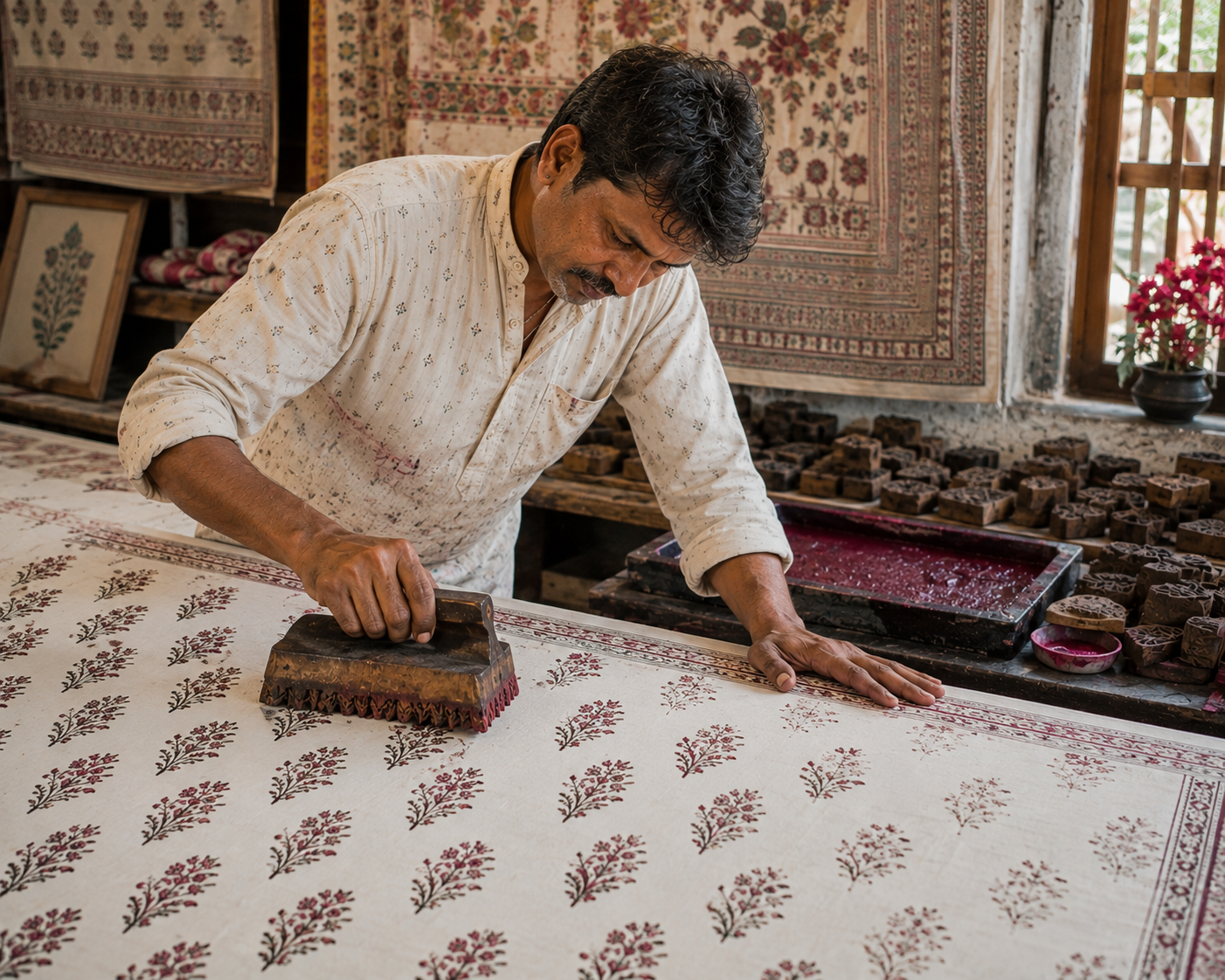
Jaipur Block Printing & Fabrics for Bedsheets: The Beauty of Cotton Sheeting
17 August, 2026